
Chinese search engine SEO, local and international
Generally, Chinese SEO is similar to Google or Bing.
This article is a beginner’s guide to Chinese search engine optimisation (SEO). You may need local Chinese support as you learn more and aim to improve your internet content rankings.
Overview
Led by Baidu, Chinese search engines have dominated domestic search for over 20 years.
Historically, Google and Chinese authorities could not find a long-term operating model. Today, Google search, applications, and many Google-hosted files are largely inaccessible on mainland networks, so Google is often accessed via VPNs.
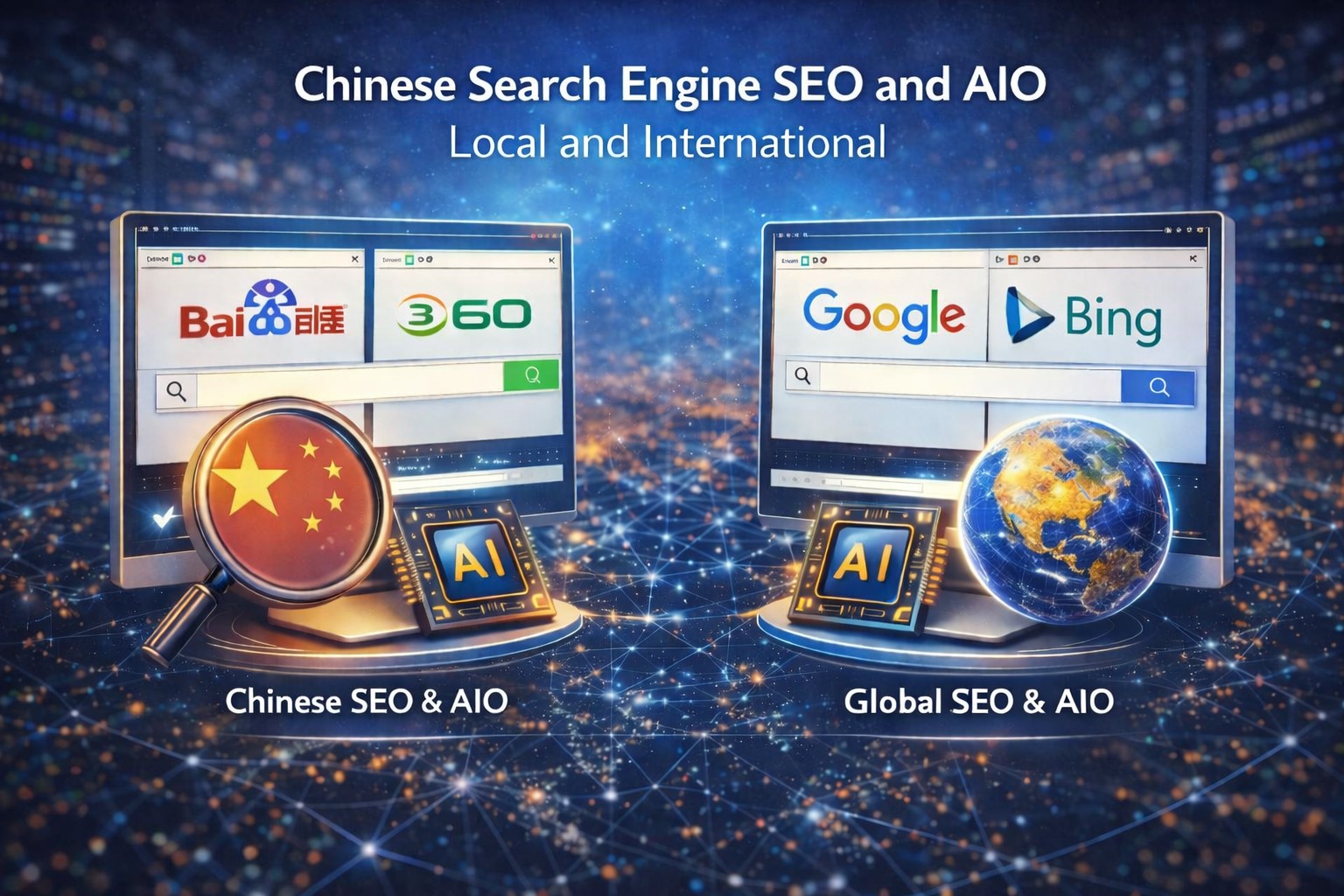
Major Chinese search engines
Baidu
Market share: 54.64%Baidu was the Google replacement in China. It filled the gap left by “Google blocked” in China. The issue with Baidu is that it's unclear which ad placements are included in the results and which listing best matches your search. This is different from Google, where ads are marked.
Bing
Market share: 24.50%Bing is accessible in China and has grown strongly in B2B usage since 2024. Microsoft’s long-term presence in China helps it operate within local rules (some content may be removed).
360 Search
Market share: 11.73%Qihoo 360 started in PC security (similar in concept to Norton). When installed, 360 products can promote 360 Search—similar to how browsers were historically bundled with operating systems.
Sogou
Market share: 2.01%Sogou is part of Tencent’s ecosystem and links to products like QQ and WeChat. Despite this, Sogou’s search share has declined as users increasingly search inside apps.
Google dominates globally, but in China it is typically accessed via VPNs and has a small share on domestic networks.
Shenma
Market share: 0.75%Shenma (Alibaba family) aims to bridge search and e-commerce by linking searches to platforms such as Tmall and JD.
Chinese SEO components
Chinese search engine SEO data, such as meta tags, titles, descriptions, and headings, is similar to that used by Google or Bing.
Remember to update the language, region, and meta tag data on the page if you have translated it or have a copy of your internet pages for the local Chinese market.
- Page title
- Page description
- Heading tags (H1, H2, H3, etc)
- Sitemaps
- Robots
- Webmasters (called Zhanzhang in Chinese)
- Fast access to your internet content
- Local/dedicated domain name
- Local/dedicated IP address
Chinese search engine sitemaps
The information is in the same format. If you have translated any information, ensure the sitemap's language information parameter is configured correctly.
Fast access to your internet content
Search engines will prioritise websites that are accessible from China. This means hosting your website in Asia, specifically in China.
Local/dedicated IP address
China uses the IP address to determine the location and reliability of your website.
Chinese search engines advise against sharing IP addresses when your internet content is compromised by other content. I dedicated an IP address to demonstrate the stability of your online presence. I don’t understand what this means.
Please note: Chinese search engines, like international search engines, aim to distinguish between high-quality and low-quality sources of information. Knowing your website's fixed location helps a great deal.
A local IP address will be allocated to your website when you host in Asia or China.
Political correctness
China has regulations governing content. If the content is politically incorrect, it is blocked in China and/or by the Chinese search engines. Make sure your website content is politically correct from the outset. Unblocking websites / IP addresses that have been blocked is very hard.
For more information, please see the Chinese ICP certification
Blocked website
Some international website content is blocked, and access times are slowed. This includes international social media platforms, such as Google and YouTube. If you have blocked embedded content, your Chinese search engine ranking will be seriously affected.
Baidu SERP (Search engine results page), e.g. Google Rich Cards
The Chinese search engine SERP enables you to incorporate the Chinese language into your SEO strategy.
Review each Chinese search to determine the available options. Given its market share, Baidu and Shenma are recommended if you sell consumer products.
Search engine tools, services and add-ons
All Chinese search engines offer additional functionality or services, such as Baidu Maps. Adding these services to your website can help improve your search engine ranking.
Review each Chinese search engine offering, starting with Baidu and Shenma.
WeChat, a search engine?
WeChat is a social media platform and belongs in a different paper.
WeChat describes itself as an IT platform that offers all the services needed to host your website, including a search engine for WeChat users.
Whilst WeChat is not called a search engine, given its business content, many Chinese consumers start their internet searches with WeChat.
WeChat, rank your WeChat account in the following sequence;
- WeChat account title
- Page headings
- Page contents
For example, when searching for "Travel / 旅行" on WeChat, the results are limited to accounts with "Travel / 旅行" in the title. If you search for "London Tower Bridge," you will first see "London Tower Bridge" results in the Account Title, followed by results containing these words in the page headings/contents.
Therefore, the account name is significant.
Create a private WeChat account and try it in your local country.

Quick checklist
Use these checks to keep trust and usability high.
- Is your content available in Chinese and/or English?
- Have you prepared Chinese language metadata?
- Have you configured sitemaps and robots correctly for each language?
- Is your website accessible from China?
- Have you reviewed blocked embedded content?
- All Chinese webmaster systems are only in the local Chinese language
- Domain name with access to Chinese DNS
- Political correctness
- Blocked internet content
- Search engine tools, services and add-ons
Need help?
If you’d like help improving mobile usability and China accessibility while keeping an authentic overseas brand feel, contact This email address is being protected from spambots. You need JavaScript enabled to view it.