
Chinese e-Commerce third-party vs website
Comparison of third-party e-commerce platforms and independent websites in China.
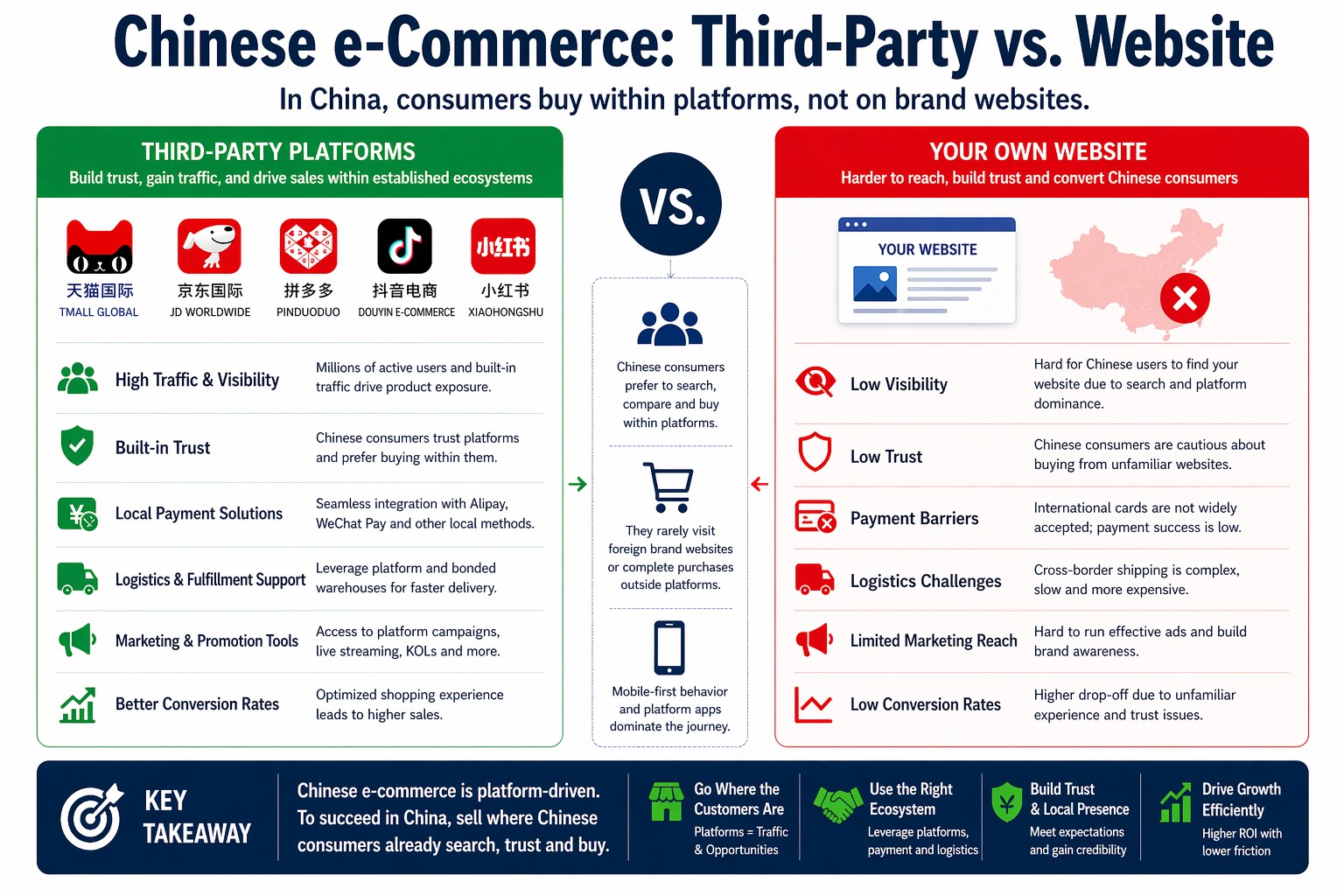
Chinese e-Commerce third-party vs website
There is a significant difference in the way the Chinese approach internet services.
Outside China, internet services have grown through businesses publishing their websites. Today, alongside business websites, there is a growing use of e-Mall department store websites, such as Amazon and eBay.
In China, the use of e-Malls, department stores, started with Alibaba (B2B marketing) and then with Amazon China, Taobao, JD.com (360buy), Tmall, etc. (B2C).
Market split between e-Commerce sites and third-party services
** This includes WeChat Mini Programs
Historically, using third-party services to start trading online in China has been cheaper and faster. While you must be a Chinese citizen or own a Chinese business to use most of these third party services, you do not need an ICP (Internet Content Provider).
Chinese Third-Party services available to overseas businesses, such as JD Buy International (Tmall), are operated from Hong Kong. As a result, overseas enterprises do not need a Chinese company or an ICP.
e-Commerce ordering processing
Customer acquisition and retention
Costs
Profit margins
** Third-party handling of both Chinese and overseas products
In summary;
- Higher margins on own website but requires significant investment.
- Third-party platforms offer scale but reduce control & profits.
- Large brands (Nike, Apple) shift to own websites for better margins & brand control.
- New & small businesses benefit from third-party platforms for faster sales.
- China relies heavily on marketplaces (Alibaba, JD, Pinduoduo, WeChat Mini-Programs) over independent websites.
A few trading statistics
1. Cross-Border E-Commerce Trade Volume:
- In the first half of 2024, China's cross-border e-commerce trade volume reached 1.22 trillion yuan (approximately USD 170.95 billion), marking a 10.5% year-on-year increase. Source: Chinese Statistics government website
- In the first quarter of 2024, the trade volume was 577.6 billion yuan (USD 79.76 billion), a 9.6% increase compared to the same period in the previous year. Source: China Daily
2. Number of Cross-Border E-Commerce Consumers:
- In 2023, approximately 189 million Chinese consumers engaged in cross-border import e-commerce, up from 167 million in 2022. Source: statista.com
3. Market Composition:
- In 2022, Business-to-Business (B2B) transactions accounted for 75.6% of China's cross-border e-commerce market. Source: statista.com
4. Growth Over Recent Years:
- Over the past five years, China's cross-border e-commerce trade has increased more than tenfold, indicating a robust expansion in this sector.
In China's cross-border e-commerce landscape, third-party platforms play a dominant role over individual websites. Here's a breakdown:
a. Dominance of Third-Party Platforms:
- In 2023, Alibaba's TMall Global, a leading cross-border platform, held a 37.6% market share. Source: fedex.com
- Other significant platforms include JD Worldwide and Kaola, collectively capturing a substantial portion of the market.
b. Preference for Third-Party Platforms:
- Chinese consumers favour these platforms due to:
- Trust and Authenticity: Established platforms implement strict quality controls, ensuring genuine products.
- Convenience: Integrated payment systems like Alipay and WeChat Pay streamline transactions.
- Comprehensive Logistics: Advanced delivery networks offer faster and more reliable shipping.
c. Impact on Individual Overseas Websites:
- While some consumers purchase directly from overseas websites, the volume is relatively lower due to:
- Concerns about Delivery Times: Longer shipping durations compared to local platforms.
- Payment Barriers: Limited acceptance of preferred Chinese payment methods.
- Customer Support: Challenges in after-sales service and returns.
Conclusion: Most of China's cross-border e-commerce transactions occur through third-party platforms, with individual overseas websites capturing a smaller market share. This trend underscores the importance of international businesses collaborating with established Chinese e-commerce platforms to reach Chinese consumers effectively.
In China's cross-border e-commerce landscape, most transactions involve physical goods such as electronics, apparel, and consumer products. However, the dynamics differ significantly regarding digital goods—including software, music, and other downloadable content.
Digital Goods Market in China:
- Domestic Platforms Dominance: Chinese consumers predominantly utilise domestic platforms for digital content. Services like Tencent's QQ Music, NetEase Cloud Music, and Baidu's software offerings cater extensively to local preferences, providing localised content and payment options that align with consumer habits.
- Regulatory Environment: China's stringent internet regulations and content censorship laws make it challenging for foreign digital content providers to operate without local partnerships. This regulatory framework ensures that digital content aligns with cultural and political guidelines, further reinforcing the dominance of domestic platforms.
Cross-Border Digital Purchases:
While specific statistics on cross-border digital purchases by Chinese consumers are limited, several factors influence this market segment:
- Payment Systems: International platforms often face integration challenges with Chinese payment systems like Alipay and WeChat Pay, hindering seamless transactions for digital goods.
- Content Localisation: Language barriers and cultural differences make foreign digital content less appealing than locally produced offerings tailored to Chinese tastes.
Conclusion:
In contrast to the robust cross-border e-commerce of physical goods, China's market for digital goods from overseas websites and platforms remains relatively limited. Domestic platforms dominate due to regulatory support, cultural alignment, and established consumer trust.
The above offers a few ideas to consider when developing your approach to the Chinese internet market.
If you have a band or range of products already known to the Chinese market, you should consider approaching it with a dedicated service.
If you are new to the Chinese market, making your current website available in China is a good starting point. Once your business is visible in China, it can create opportunities to find agents and build partnerships.
Quick checklist
- Are you targeting B2B, B2C, or both in China?
- Do you need fast market access or long-term brand control?
- Can you meet platform commission and service fees?
- Do you require Chinese payment gateways and local logistics?
- Are regulatory approvals or product certifications required?
- Is your brand already recognised by Chinese buyers?