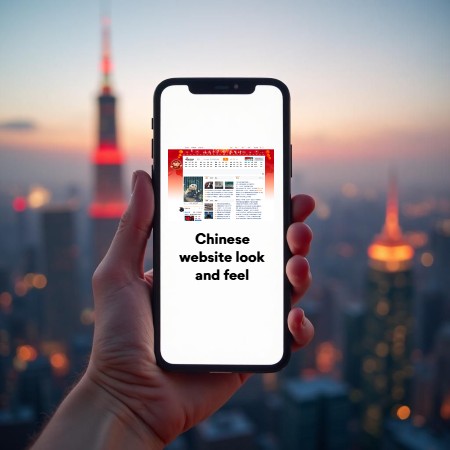
Chinese website look and feel
Chinese companies and consumers want overseas websites that look and feel like websites in their home country — not a “Chinese-looking” site that raises authenticity questions.
The priority is accessibility + trust: your pages must open reliably in China and display cleanly on mobile and tablets (often inside the WeChat browser).

Website look-and-feel for the Chinese market
Chinese companies and consumers want overseas websites that look and feel like those in their home country. They do not want to see a “Chinese-looking” site that calls into question the authenticity of products or services.
We recommend keeping your website’s look and feel unchanged for the Chinese market, provided it has a responsive design and displays clearly on mobile and tablet devices.
Why trust matters
The credibility of information, products and services on the internet has been an issue for many years. People ask: is the information accurate, and is the product genuine?
You need to build trust in your website.
Trust checklist
- Make sure your website can be opened in China.
- Make sure your website can be seen in China (full page loads, not just ping tests).
- Keep your business information up to date.
- Keep your and your business’s contact details updated and working.
- If you sell online, test the full e-commerce journey (including shipping) end-to-end from inside China.
In China, it can be difficult to tell if a product is a “copy” product. Maintaining your website’s overseas look and feel helps customers have confidence that your products are genuine.
Mobile and tablet experience
Most websites, social media platforms and online services in China are accessed via mobile devices.
Shenma: a mobile-first signal
Shenma (a major Chinese search engine) was designed exclusively for mobile and tablet users, focused on consumer e-commerce. Being mobile-only reduced development and modification costs, and its success reinforced the view that Chinese consumers are primarily mobile/tablet users.
Shenma website: https://m.sm.cn/
WeChat browser reality
Today, the WeChat platform’s default screen size is mobile/tablet format. Websites are often accessed via the WeChat browser, underscoring the importance of mobile/tablet formats for businesses targeting the Chinese market.
Responsive design (dynamic layout)
A dynamic website is one where the presentation of content changes with the size of the screen used to view your data and multimedia. This is commonly called a responsive website design.
Changes in Chinese internet content
Historically, traditional Chinese websites were full of information and used the entire desktop screen (for example: sina.com).
Chinese written words contain about 30% less text than English, and Chinese does not use spaces between words. One page of Chinese content can contain around 50%–60% more information than an English page.
Chinese website design has undergone significant changes over the last ten years. These changes do not necessarily make content appear “Western” in style.
Due to widespread use of mobile and tablet devices, page layouts have shifted toward columns with clearer linking between pages — because mobile formats demand it.
Our recommendations
- Given that Chinese internet users are primarily mobile and tablet users, ensure your websites are mobile and tablet-friendly.
- Keeping your website in your local format helps keep a “genuine” look and feel for your brands, products and services.
- Only put the minimum Chinese language on your website pages. If you fully translate your website, you may be mistaken for a Chinese agent.
Quick checklist
Use these checks to keep trust and usability high.
- Does the full page load reliably in China (including third-party resources)?
- Is the design responsive and readable on mobile/tablet screens?
- Do key pages work inside the WeChat browser (not just desktop Chrome)?
- Are contact details current and working (email, phone, address, forms)?
- If e-commerce: can users complete the full checkout and shipping journey from China?
- Have you kept Chinese language minimal to avoid appearing like a local agent site?
Need help?
If you’d like help improving mobile usability and China accessibility while keeping an authentic overseas brand feel, contact This email address is being protected from spambots. You need JavaScript enabled to view it.