Internet content provider: ICP licensing and certification
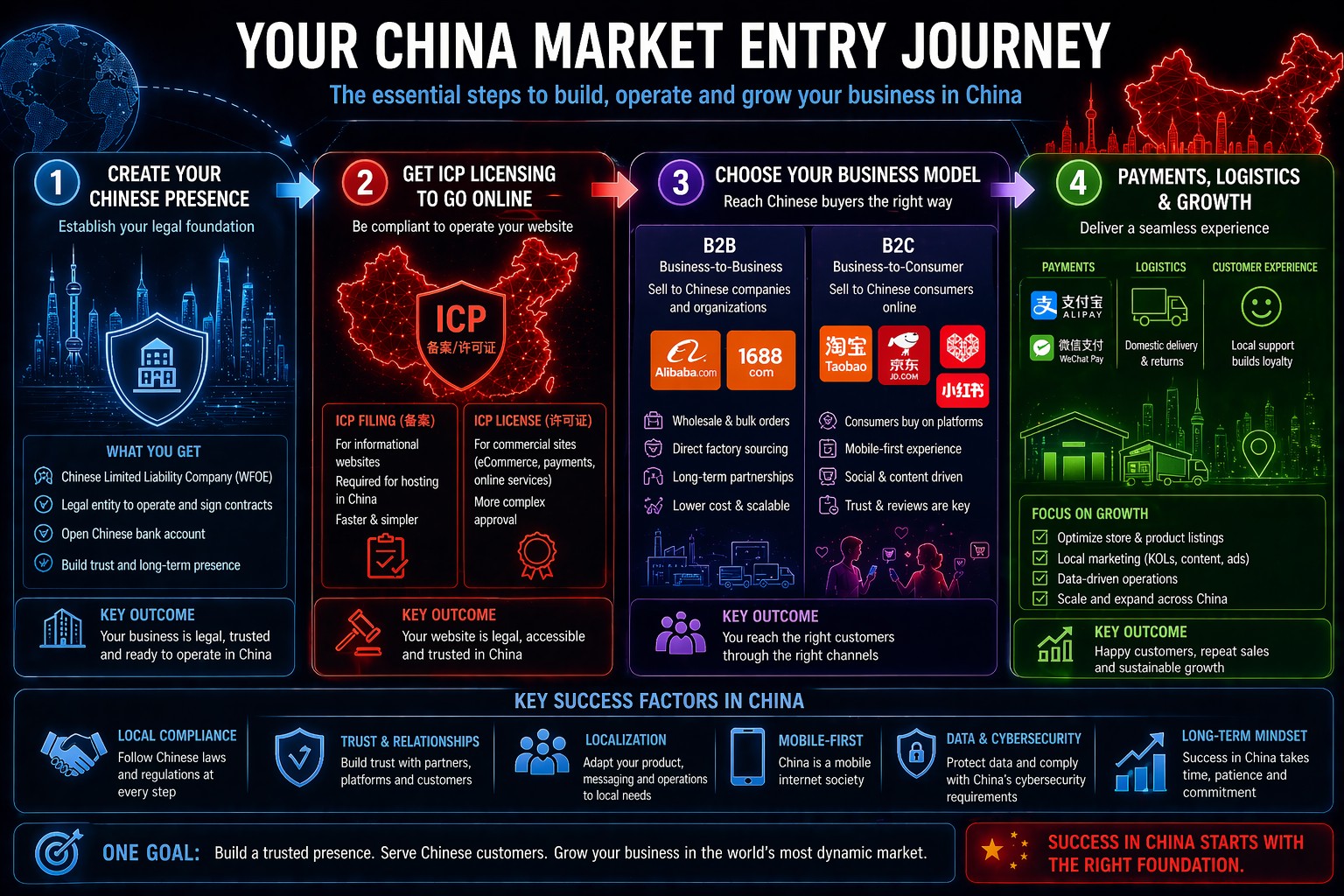
ICP licensing and ICP certification are required for many types of public internet content hosted inside mainland China.
This guide explains when ICP is required, what is monitored (domains, Chinese IPs, ports), and how to plan safely before opening public web ports.
Internet content provider licensing and certification
An ICP licence and ICP certification are required for many types of public internet content inside mainland China.
ICP certification can apply to domain names, apps, and Chinese IP addresses.
If your content is internal-only and not publicly accessible, ICP certification is usually not required; however, even a login screen on a domain may require ICP if publicly reachable.
ICP types and additional approvals
There are different types of ICP depending on whether you are publishing content, trading online, or running services in a data centre.
In general, most business content falls under standard ‘business internet content’ or ‘business online trading’, but some sectors require additional approvals.
- Electronic bulletins
- Medicine / drugs
- Medical
- Broadcasting (TV, Radio, etc.)
- News
- Videos
- Banking, stock trading, auctions, payments, etc.
- EDI telecommunications, data centres, call centres
Where to check ICP status
The official ICP filing website is:
beian.miit.gov.cn (Chinese language only; Chrome translate can help).
Only a Chinese business can apply for an ICP licence and ICP certification.
What the authorities monitor
Monitoring is prioritised based on domain names published on Chinese IP addresses and publicly open ports (80, 8080, 443).
A port identifies which server process receives network traffic. The default web port for a domain is 80.
You can test services from inside mainland China on a non-public port before opening the public web ports. This is often implemented via port mapping.
Displaying the ICP number
Once certification is issued, you must display the ICP number in the footer of the internet content.
The ICP number should link to the official ICP website (example format: 苏ICP备10037052号-2).
The main number is your company ICP number; the suffix is usually per domain.
Domains, subdomains, and IP risk
You generally need one ICP certification for the primary domain if you are using subdomains.
If there is a problem with internet content, the Chinese authorities can close the IP address. Because of this, hosting on a shared IP address in China can be risky.
Trust building with the ICP authorities
When adding a domain to your China company profile for the first time, it can help to notify the ICP authorities before opening public ports.
Authorities also check that your domain does not conflict with registered brand names — another reason to register your brand in China early.
They may also verify your internet content matches your company’s registered business scope (e.g., ‘building materials’ must be in scope if promoted online).
Do you need an ICP certificate?
If you need an ICP certificate, you must create a Chinese company, apply for an ICP licence, and then request ICP certification for each website/app you publish.
Alternatively, you can reach an agreement with a Chinese company that holds an ICP licence and can file on your behalf — but they are legally responsible for your content.
Online trading inside mainland China requires local payment systems, sales tax, returns handling, and company tax compliance.
ICP certification options overview
The table below summarises common platform scenarios and whether ICP, ICP trading approval, and a Chinese business are required.
| ICP Certification Options | ICP Required? | ICP Trading Required? | Chinese Business Required? |
|---|---|---|---|
| Platforms | |||
| International search engines (a) | No | No | No |
| Chinese search engine (b) | No | No | No |
| International retail e-Malls (c) | No | No | No |
| Chinese International Retail e-Malls (d) | No | No | No |
| Chinese Local Retail e-Malls (e) | No | No | Yes * |
| Chinese business platforms (f) | No | No | No |
| International media channels (g) | No | No | No |
| Chinese media channels (h) | No | No | Yes |
| International Social Media (i) | No | No | No |
| Chinese social media (j) | No | No | Yes ** |
| International Internet of Things (k) | No | No | No |
| Chinese Internet of Things (l) | yes | yes | yes |
| SaaS | |||
| International public network (m) | No | No | No |
| Chinese enclosed network (n) | No | No | No |
| Chinese white Label (o) | Yes *** (Customer) | Yes *** (Customer) | Yes *** (Customer) |
| Chinese public (p) | yes | Yes | Yes |
| A split service between Chinese and international SaaS (q) | Yes | Yes / No **** | Yes |
| Your internet presence | |||
| International (r) | No | No | No |
| Inside mainland China (s) | Yes | Yes / No **** | Yes |
Notes: requirements can vary by service model; for software trading, ICP trading may be required only when trading is enabled.
Chinese ICP monitoring and content rules
Internet content is monitored in China regardless of where it is published, but priority is based on use inside mainland China and audience size.
Rules are updated regularly and often focus on protecting users from misleading or harmful practices.
Content can be blocked if it is inappropriate for the Chinese internet or if the required ICP certification is missing.
Use these checks before hosting public content inside mainland China.
Quick checklist
Use these checks to keep trust and usability high.
- Is the content public (reachable from the internet) or internal-only?
- Are public ports (80/8080/443) open on a China-hosted IP address?
- Does the domain name conflict with any registered brand names in China?
- Does your company's business scope cover what you publish online?
- Have you planned where the ICP number will be displayed in the site footer (with a link)?
Need help?
If you’d like help improving mobile usability and China accessibility while keeping an authentic overseas brand feel, contact This email address is being protected from spambots. You need JavaScript enabled to view it.